Understanding Octopus Brain Anatomy and Behaviour
- contentmaniacsinte
- 12 minutes ago
- 4 min read
Octopuses are among the most fascinating creatures in the ocean. Their intelligence and unique behaviours have intrigued scientists and curious minds alike for decades. When I first started exploring the world of octopuses, I was amazed by how complex their brains are and how this complexity shapes their behaviour. In this post, I want to share what I’ve learned about octopus brain anatomy and how it influences their remarkable abilities.
Exploring Octopus Brain Anatomy
The octopus brain is unlike that of any other animal. It is highly developed and quite large relative to its body size. What makes it even more interesting is that the octopus does not have just one brain but a distributed nervous system. The central brain is located between the eyes, wrapped around the oesophagus, and controls overall body functions and decision-making.
In addition to this central brain, octopuses have large ganglia in each of their eight arms. These ganglia act like mini-brains, processing information locally and allowing the arms to perform complex tasks independently. This means an octopus can multitask in ways that seem almost alien to us.
The brain structure supports their incredible problem-solving skills, memory, and learning capabilities. For example, octopuses can navigate mazes, open jars, and even use tools. This is all thanks to their sophisticated neural architecture.

An octopus arm with suckers demonstrating its complex nervous system.
If you’re curious about how many brains does an octopus have, the answer is quite surprising. They have one central brain and eight smaller brains in their arms, making a total of nine brains working together.
How Octopus Brain Anatomy Influences Behaviour
The unique brain anatomy of octopuses directly impacts their behaviour. Because each arm can operate semi-independently, octopuses can explore their environment in a highly efficient way. This autonomy allows them to react quickly to threats or opportunities without needing to process everything through the central brain.
For instance, when hunting, an octopus can use one arm to probe a crevice for prey while the other arms continue to move or camouflage the body. This multitasking ability is rare in the animal kingdom and highlights the evolutionary advantage of their brain design.
Octopuses are also masters of camouflage, changing their skin colour and texture to blend into their surroundings. This behaviour is controlled by their nervous system, which sends rapid signals to specialised skin cells called chromatophores. The speed and precision of this response are astonishing and show how well their brain and body communicate.
Their intelligence also shines in social interactions and problem-solving. Octopuses have been observed using coconut shells as portable shelters, demonstrating foresight and tool use. These behaviours suggest a level of cognitive complexity that rivals some vertebrates.
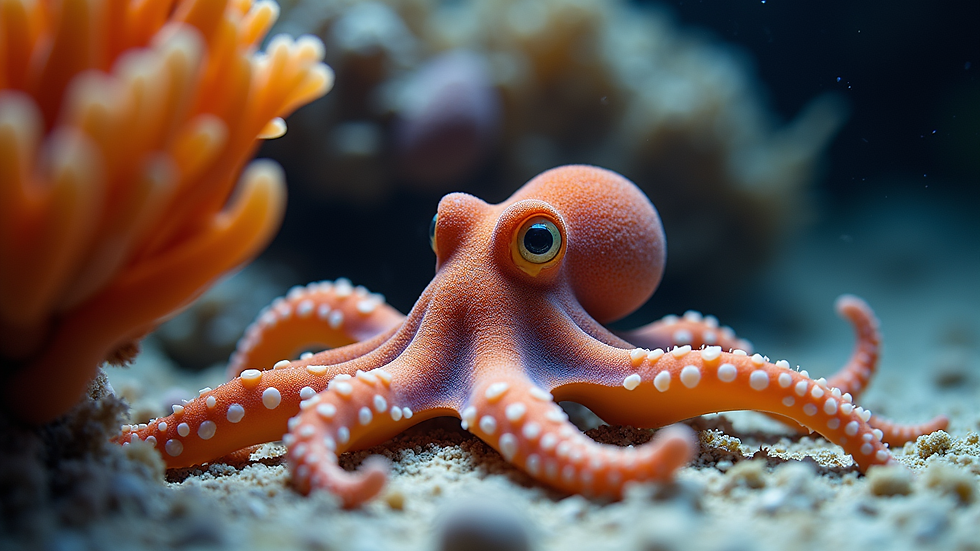
An octopus camouflaging itself against a coral reef, showcasing its adaptive behaviour.
What is the IQ of an Octopus?
Measuring the IQ of an octopus is not straightforward because IQ tests are designed for humans. However, scientists assess their intelligence through problem-solving tasks, learning experiments, and memory tests. Octopuses consistently perform well in these tests, showing advanced cognitive abilities.
For example, octopuses can learn to navigate mazes, remember solutions to puzzles, and even recognise individual humans. Their ability to adapt to new situations and learn from experience is a strong indicator of high intelligence.
Some researchers compare octopus intelligence to that of a dog or a crow, both known for their problem-solving skills. While it’s not an exact comparison, it helps us appreciate the octopus’s mental capabilities.
Their intelligence is also evident in their curiosity. Octopuses often explore new objects in their environment, manipulate items, and show playful behaviour. This curiosity is a sign of a complex brain capable of learning and adapting.
Practical Insights from Octopus Behaviour
Understanding octopus brain anatomy and behaviour offers practical insights for various fields. For example, robotics engineers study octopus arms to design flexible, adaptive robots. The way octopus arms move independently yet coordinate with the central brain inspires new approaches to artificial intelligence and machine learning.
In marine biology, studying octopus behaviour helps us understand how animals adapt to complex environments. Their problem-solving skills and adaptability provide clues about evolution and intelligence in invertebrates.
For anyone interested in animal behaviour, octopuses are a perfect example of how brain structure influences actions. Observing them can teach us about multitasking, learning, and adaptation in ways that apply beyond the ocean.
If you ever get a chance to watch an octopus in an aquarium or in the wild, pay attention to how it moves its arms, changes colour, and interacts with its surroundings. These behaviours are direct reflections of its unique brain anatomy.
The Future of Octopus Research
The study of octopus brains and behaviour is still evolving. New technologies like brain imaging and genetic analysis are opening doors to deeper understanding. Scientists are uncovering how octopuses process information, control their limbs, and even how their emotions might work.
One exciting area of research is the exploration of octopus consciousness. While it’s difficult to define consciousness in animals, the complexity of octopus behaviour suggests they might experience the world in ways we are only beginning to grasp.
As research progresses, we may discover even more surprising facts about these incredible creatures. Their intelligence challenges our assumptions about what it means to be smart and how brains can be organised.
For those fascinated by the natural world, following octopus research is a rewarding journey. It reminds us that intelligence comes in many forms and that the ocean holds many secrets waiting to be uncovered.
I hope this exploration of octopus brain anatomy and behaviour has sparked your curiosity. These creatures are a testament to the wonders of evolution and the diversity of life on Earth. Keep exploring, keep questioning, and enjoy the fascinating world of facts!


